Kleerkast Voor De Wapenrok: Navigating the Nuances of a Challenging Crossword Clue
The world of crossword puzzles is a fascinating labyrinth of language, logic, and lateral thinking. For Dutch puzzle enthusiasts, clues can often transcend simple definitions, delving into historical context, wordplay, and unexpected associations. One such intriguing clue that frequently baffles and delights solvers is "
Kleerkast Voor De Wapenrok." At first glance, it appears straightforward, but as many discover, its potential answers span a surprisingly broad spectrum, from articles of clothing to hazardous materials. This comprehensive guide will unravel the layers of this captivating clue, explore its diverse solutions, and provide strategies for conquering similar linguistic challenges.
Deconstructing "Kleerkast Voor De Wapenrok": A Linguistic Deep Dive
To truly appreciate the complexity of "Kleerkast Voor De Wapenrok," we must first dissect its individual components and their historical significance.
*
Kleerkast: Literally translating to "wardrobe" or "closet," this word suggests a place of storage for garments. In a broader sense, it can also refer to a cabinet or even a system of categorization.
*
Wapenrok: This term carries a rich historical weight. "Wapen" means "weapon" or "coat of arms," and "rok" means "skirt" or "robe." Historically, a
wapenrok was a surcoat or tunic worn over armor, often emblazoned with the wearer's heraldic crest or "coat of arms." It served as identification, protection, and a symbol of status in battle or ceremonial contexts. Think of medieval knights displaying their family symbols. In a more general sense, it can also refer to any kind of protective or official attire, especially one worn in combat or for a specific duty.
Combining these, "Kleerkast Voor De Wapenrok" literally means "Wardrobe for the Surcoat/Battle Coat." On the surface, one might expect answers related purely to clothing storage. However, the true brilliance of crossword setters lies in their ability to twist literal meanings into metaphorical or even abstract connections, demanding a deeper understanding of language and context. This clue is a prime example of such ingenuity, leading solvers down various, often unexpected, paths.
Unveiling the Answers: From Attire to Anomaly
The beauty of "Kleerkast Voor De Wapenrok" lies in the remarkable range of its potential solutions, each requiring a different interpretive leap. Let's explore the answers identified in various puzzle databases and decipher the logic behind them.
The Obvious Attire: Uniform and Tabberd (7 letters)
*
Uniform: This answer is perhaps the most intuitive. A
wapenrok, particularly in its military or ceremonial context, functions as a type of uniform. It’s standardized attire worn by a group for identification or protection. A "Kleerkast Voor De Wapenrok" could very well be a place where a *uniform* is stored. This solution is a direct, albeit slightly modernized, interpretation of the historical garment.
*
Tabberd: Known in English as a "tabard," this is an almost perfect synonym for a
wapenrok. A tabard is a short, sleeveless or half-sleeved coat, often decorated with heraldic arms, historically worn by knights over their armor or by heralds. It fits the description of a ceremonial or battle-ready tunic perfectly. Storing a tabard would logically occur in a "wardrobe for the battle coat."
These solutions leverage the primary meaning of *wapenrok* as a specific type of garment, directly linking the storage (kleerkast) to the item being stored.
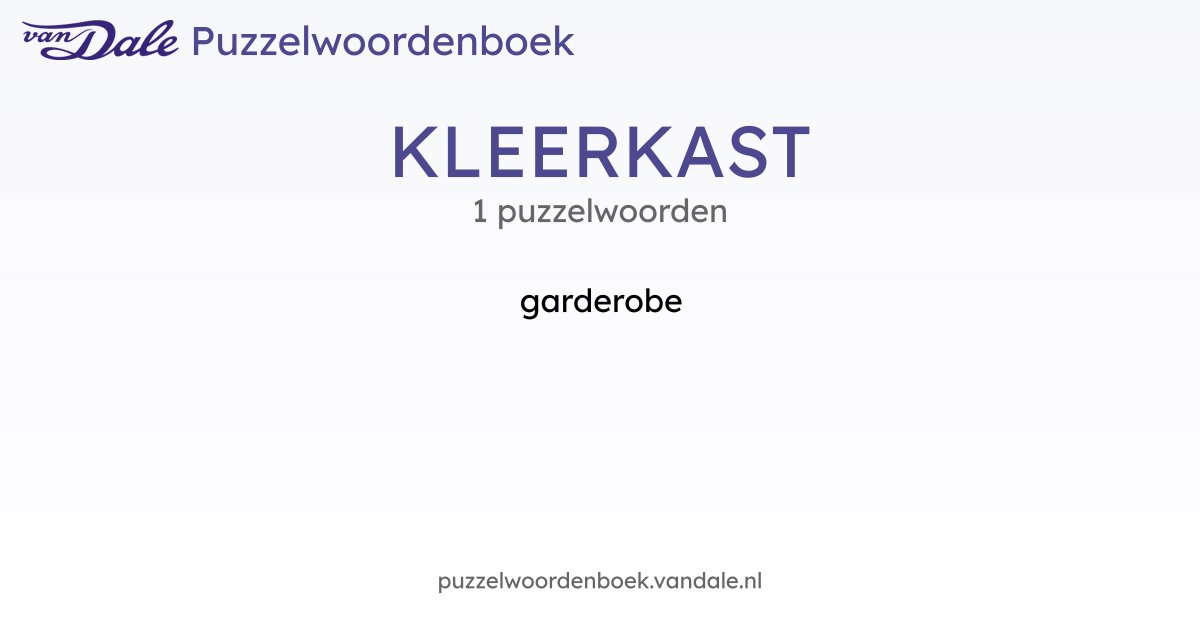
The Direct Storage Solution: Garderobe (9 letters)
*
Garderobe: This Dutch word translates directly to "wardrobe" or "cloakroom" in English. It's the most literal answer to the "Kleerkast" part of the clue. If the clue focused solely on "Kleerkast," "garderobe" would be a no-brainer. Its connection to "Wapenrok" implies that a garderobe is simply a general place where all sorts of attire, including specialized historical garments like a *wapenrok*, would be kept. It's a pragmatic and encompassing solution for the "storage" aspect.
The Modern Protective Gear: Kogelvrijvest (13 letters)
*
Kogelvrijvest: This translates to "bulletproof vest" in English. This is where the clue takes a fascinating, modern turn. A *wapenrok* historically provided protection in battle. A bulletproof vest serves the exact same fundamental purpose in contemporary contexts: protecting the wearer in hazardous situations. Thus, a "Kleerkast Voor De Wapenrok" can be interpreted metaphorically as a "cabinet for protective battle gear," leading to the modern equivalent. It requires a significant leap in time and a focus on the *function* of the item rather than its historical form. This clever interpretation highlights the dynamic nature of language in puzzles.
The Utterly Cryptic Anomaly: Gevaarlijke Stoffen (18 letters)
*
Gevaarlijke stoffen / Gevaarlijkestoffen: This answer, meaning "dangerous substances" in English, is by far the most intriguing and challenging. How does "Wardrobe for the Battle Coat" lead to "dangerous substances"? This requires a multi-layered, abstract, or highly metaphorical interpretation:
*
Metaphorical "Battle Coat": One could argue that when dealing with "dangerous substances," one needs to "don a battle coat" metaphorically – meaning, prepare with extreme caution, protective gear, or a specific mental fortitude. The "kleerkast" might then be the cabinet *containing* these substances, for which special "attire" (metaphorical or actual protective suits) is required.
*
Cabinet of Hazards: "Kleerkast" could be interpreted as a generic "cabinet" or "storage unit." "Wapenrok" could be broken down. "Wapen" means weapon. Could "wapenrok" be loosely associated with something that is dangerous or necessitates extreme care, much like a weapon? A "cabinet for (items requiring) a battle coat" then becomes a "cabinet for dangerous substances."
*
Context of Protective Gear: In laboratories or industrial settings, hazardous materials are often stored in specific cabinets ("kleerkast") and require special protective clothing ("wapenrok" in a very broad, functional sense, like a hazmat suit) to handle. The clue implies a storage unit that *necessitates* wearing protective attire because of its contents.
This solution exemplifies the genius of cryptic crosswords, pushing solvers to think far beyond literal translations and consider abstract connections, puns, and broader contextual implications. For more on this fascinating transition, explore
From Uniform to Dangerous Substances: Wapenrok Clue.
Strategies for Cracking Cryptic Dutch Crosswords
Solving clues like "Kleerkast Voor De Wapenrok" demands a versatile approach. Here are some strategies to enhance your crossword-solving prowess:
1.
Master Letter Counts: Always start by matching your known letters with the possible answer lengths. This immediately narrows down the field. For "Kleerkast Voor De Wapenrok," knowing it's 7, 9, 13, or 18 letters is paramount.
2.
Break Down the Clue: Analyze each word individually. What are its literal meanings? Its historical context? Its common idioms? For "Wapenrok," thinking of both the garment and its *function* (protection, identification) is key.
3.
Consider Synonyms and Antonyms: Crosswords often rely on synonyms, but sometimes, a clue might hint at an opposite to lead you to the answer.
4.
Embrace Wordplay and Puns: Dutch crosswords are renowned for their clever use of wordplay. Look for hidden meanings, homophones, or words that sound similar but have different spellings/meanings.
5.
Think Figuratively and Metaphorically: As seen with "Kogelvrijvest" and "Gevaarlijke stoffen," clues can move beyond literal definitions into abstract concepts or modern equivalents of historical items.
6.
Utilize Cross-References: What other answers in the puzzle have you already solved? They might provide crucial letters or contextual hints for the trickier clues.
7.
Consult a Puzzle Database: If truly stuck, don't hesitate to use online crossword databases. Enter the clue and any known letters (e.g., _ r o _ e m) to see possible solutions and learn from them. This helps train your brain for future puzzles.
8.
Understand Cultural Nuances: Some clues might reference specific Dutch history, proverbs, or cultural touchstones. Familiarity with these can be a huge advantage.
By employing these techniques, you'll be better equipped to tackle the imaginative world of Dutch word puzzles. To delve deeper into the various interpretations and meanings, consider reading
Unraveling "Kleerkast Voor De Wapenrok" Puzzle Meanings.
Beyond the Solution: The Art of Dutch Word Puzzles
The journey to solve a clue like "Kleerkast Voor De Wapenrok" is more than just finding the right word; it's an exercise in linguistic agility and cultural understanding. It highlights how language evolves, how words carry multiple layers of meaning, and how puzzle setters artfully manipulate these elements to create engaging challenges.
Dutch crosswords, with their intricate wordplay and often surprising answers, serve as a testament to the richness of the Dutch language. They encourage solvers to think outside the box, to appreciate historical context, and to make imaginative leaps that connect disparate concepts. The satisfaction derived from finally cracking a seemingly impossible clue, especially one as multifaceted as "Kleerkast Voor De Wapenrok," is immense, reinforcing the joy and intellectual stimulation that puzzles offer.
Conclusion
"Kleerkast Voor De Wapenrok" stands as a prime example of a brilliantly crafted crossword clue – one that transcends simple definitions to explore history, function, and abstract connections. From the literal storage of a "uniform" or "tabberd" to the metaphorical cabinet of "dangerous substances," each solution offers a unique insight into the cleverness of puzzle design. By understanding the linguistic roots, considering various interpretations, and employing strategic problem-solving techniques, enthusiasts can transform this challenging clue into a rewarding triumph. So, the next time you encounter a seemingly impossible Dutch crossword, remember the "Kleerkast Voor De Wapenrok" and prepare to embark on a delightful journey through the fascinating world of words.